
The Graveyard of Good Ideas
The software that nearly killed my first business would probably take a weekend to build today.
EcoCaddy started with a simple observation: every modern city has an underutilised asset running straight through the middle of it… the bicycle lane. Factor in relative speed, and a bike beats a taxi across the CBD. All we needed was a trike that could carry two passengers plus a rider at 15–20km/h (the electric motor came from a manufacturer I'd met during my years in Shanghai), and a way for customers to hail us. Because the moment we touched a taxi rank or called ourselves a taxi, we'd be regulated out of existence.
So let’s quickly talk about ride hailing software. Building it in 2013, ahead of our 2014 launch, cost over $150,000…which was most of my first round of angel investment.
It almost worked. But, GPS shadowing in the CBD could put a Caddy 200 metres from where the app said it was… which, at 11pm on a Saturday with a customer three drinks deep who won't come out of the club, is mayhem. We burned thousands trying to fix it. Uber was fighting the exact same problem at the exact same time; the difference was they had a war chest and we had what was left of the raise.
You know how it ended? Our customers told us they preferred texting the rider directly. So we ran the operation on SMS and phone calls, alongside our very expensive software. And here's the thing… in 2014, texting your rider on a trike was still a better experience than a taxi switchboard.
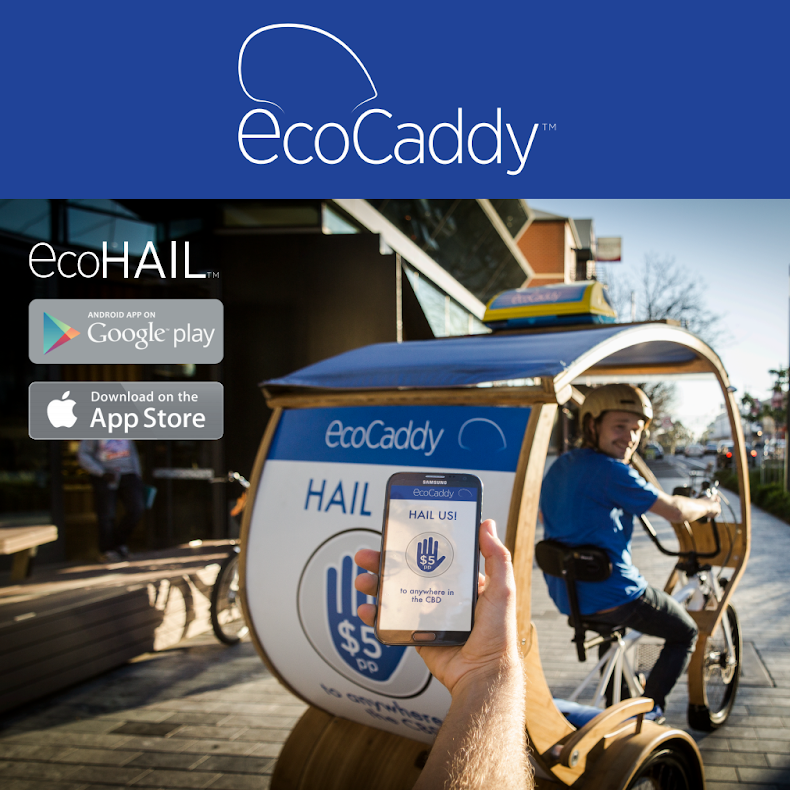
The EcoCaddy ecoHail App
The idea kept being right. The era kept being wrong.
We pivoted. A lot. Fares alone couldn't carry the business, so we added parcel delivery to make the return trips pay. Then we became a fully fledged out-of-home media company, selling premium advertising space in and on the cabs… a genuinely solid model in the warmer months, strong enough to take us into Melbourne and Sydney and put us at events like Xerocon and on Chapel Street. We even ran boutique tours built on Google My Maps, coordinated our riders over walkie-talkie apps before WhatsApp had voice notes, on Android phones strapped to the handlebars — years before Uber Eats and DoorDash made that a normal thing to see on a city street.
Notice the pattern. None of those pivots failed because the thinking was wrong. Almost every one of them is a thriving category now. We just kept arriving early, and early is expensive… especially in the one line item that never got cheaper: the software.
Then COVID hit, and this is where the story gets interesting.
The two-week build
Lockdowns meant only essential services could operate. Insurance payouts had tanked the market, we couldn't get public liability cover, and the fare business was dead overnight. So I pivoted EcoCaddy one last time, wait for it…. into waste management. Yep! An industry that hadn't meaningfully changed in Australia in 30 years.
In two weeks, I hacked together an online pitch-deck app with Stripe for payments. We built an articulated trailer that let our electric-assist trikes haul 800kg of food waste out of the busiest restaurants, cafes and supermarkets in the CBD. And I used Glide Apps to build a simple app so my riders could track serial-numbered bins… which quietly became one of the most detailed datasets on food waste in the country.
It worked pretty damn well. We went from 1 customer to 80 in six months, running seven days a week with several vehicles, and expanded into offices.
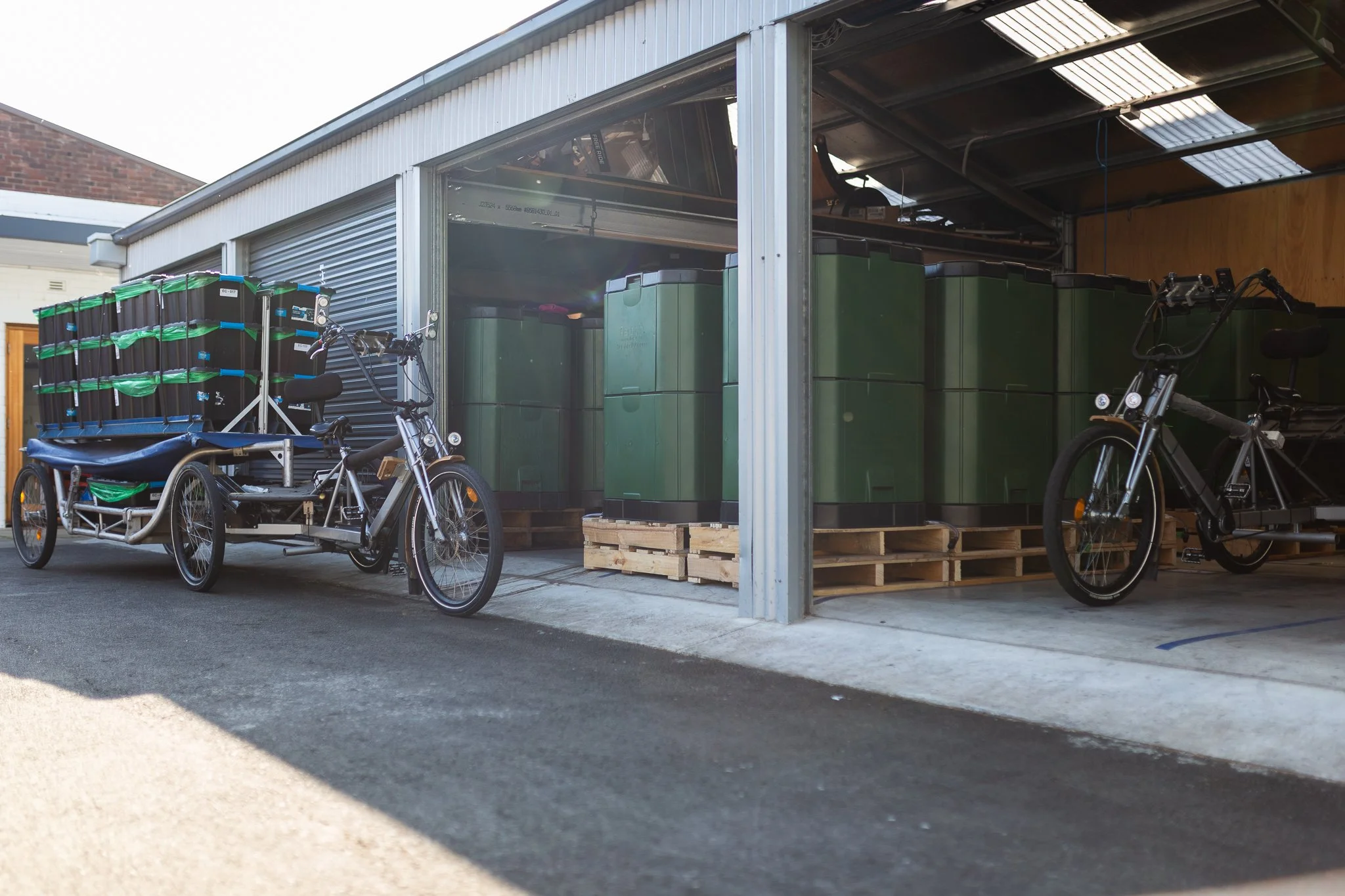
EcoCaddy Organics trikes, trailers and compost facility in the heart of the Adelaide CBD
Now compare the two builds. 2013: $150,000, an agency, most of my raise, beaten by SMS. 2020: two weeks, no-code tools, built by me between shifts and it carried a real, growing business.
But then the Glide app hit a wall. As the dataset grew, it slowed. The tools that got us moving couldn't carry the weight of what we'd become. And I knew — precisely, painfully, from experience — what a real application would cost to build. The wall hadn't disappeared between 2013 and 2020. It had moved. In 2013 it stood at the front door: getting into software at all took six figures. By 2020, no-code let anyone through the front door for a much smaller fee— and then you could build something real, until it needed to become something serious.
The best time in history
The idea for this essay came from Patrick Collison — whose conference started this series of essays, and whose products have appeared in every chapter of my working life, from wiring Stripe into a coworking space in 2016 to taking waste-management payments through it in 2020. In a recent conversation with Replit's founder, he described where we're heading: a world in which "the marginal cost of producing software plummets, maybe asymptotes to close to zero."
When I heard that, I thought about my $150,000.
Every era's failed businesses form a graveyard, and we tell ourselves they died because the ideas were bad. Mostly they weren't. Webvan delivered groceries in 2001 and collapsed; Instacart built the same idea into a giant once the smartphone existed. The graveyard is full of companies that were simply early… right about the need, wrong about the decade — and for small operators, the thing that made "early" fatal was nearly always the same line item that nearly killed EcoCaddy twice.
Collison's advice for where to look next fits this exactly: find the domains where software hasn't yet been properly brought to bear. He points out that startups themselves were once that overlooked market… it's why Stripe had no competition selling to them fifteen years ago.
But I'd add a direction to his advice: look backwards.
What to build: dig in the graveyard
This is not meant to sound as morbid as it does…what I mean is while everyone else chases whatever's newest, the more interesting question is what was right but early.
Three places to dig.
Your own shelved ideas. Everyone who's spent a decade in an industry has a graveyard of their own.. the tool you priced up and couldn't afford, the idea you shelved because it "would need an app." Those ideas were killed by a cost that no longer exists. They deserve a retrial.
The thing you've done a hundred times. The physio's follow-up system, the designer's quoting process, the accountant's onboarding… the process you've run so often you could map it blindfolded. That map is the specification. The expensive part was always turning the map into software, and that's the part that collapsed.
Your industry's oldest "that's just how it's done". Waste management hadn't changed in 30 years when I turned up with a trike and a Glide app. Every industry has a corner like that — a process everyone complains about and nobody fixes, because fixing it was never worth the software bill. It is now.
Permission to build small
One last thing… and its important because the headlines will try to talk you out of this.
You do not need to build a unicorn. Ten-month-old AI startups raising hundreds of millions make for great reading and terrible benchmarks. The maths that actually matters is much smaller: solve a problem for yourself, and you've bought back your own hours. Solve it for a thousand people, and you've got a business. Either one is a really nice adventure.
The graveyard is full of good ideas that died waiting for this moment. Some of them are yours.
Bring one back. We're at 451 Pulteney Street
Thanks for reading. I’m Dans the founder of Mâché (mash-aye), a coworking community I’ve built since 2016. Say hi on LinkedIn.